Wednesday, January 1, 2014

Birdlog #3 - 01-01-14: More birdy small talk, getting to know Louis and James

Again, today there aren't many birds at our feeders except a couple house Finches and maybe a Dark-eyed Junco or two. Which is one of the reasons that I hate winter: The only birds you see are the regulars, making today's rounds at your feeders.


Louis (left) and James (right).
So for a couple months I've had some pet budgerigars (FYI, for all you non-birdlovers, a Budgerigar is just a type of parakeet). They're names are Louis and James. Louis is green with a yellow head, and James is blue with a white head. Like most parakeets, they both have barring on the back of their heads. Why haven't I posted about them? Well, originally this blog was about wild birds. Well, since you voted yes, now I can. I wasn't keeping 'em secret!
I bet that Louis is the squirmiest Budgerigar that you'll ever see. And when we first got him, he broke his tail against the bars of the cage. In fact, you can see it in that picture to the left of this writing.
James is weird. He kinda flip-flops in between biting you and not biting you if you stick your hand in the cage. If he's stressed, sometimes he'll even fluff up and rush at your hand!
I'm not exactly sure about their ages/gender, but I'm pretty sure that they're both at least 8-9 months old. James is totally a boy, but I'm not sure about Louis. I think he's a boy, too.
You can tell a Budgerigar's gender by the cere, or, for you non-birdlovers, the little bit of skin covering the nostrils. On a boy it's neon blue, but on a girl it can be pink or brown. And as your bird gets older, his/her cere will begin to look crusty, but do not fear! It's completely normal. And if he/she grows little things that look like pepper, it means he/she's molting. And he/she'll get kinda moody, so you won't wanna take it out for a while. But when it's done molting (6 weeks or so), feel free you handle him/her again!

End.

The Monthly Bird #1: Lazuli Bunting

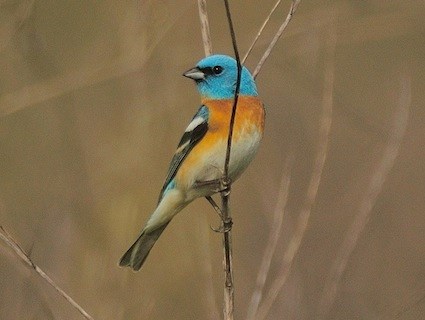
Lazuli Bunting, adult male.
"What a beautiful bird!"

You could say that about a couple hundred bird species - easily - but the Lazuli Bunting's mixture of shiny lazuli blue, bluebird brown, black and white makes this bird beyond compare.

What gives it its bright colors? I won't go into all the details, but I think it goes something like this: These things called pigments are in the feathers, and when the sun's light hits the feathers, we see the bright blue on the head and back. But colors can be tricky: Like other buntings, when not seen in good light, parts of the bird may appear dark blue or even black. I'm pretty sure that you can see the brown/orange in poor light, though.


Like most songbirds, they eat seeds, fruits and bugs. Again, like most songbirds, they come to feeders. And they're really versatile when it comes to finding food. They'll eat in the trees or in bushes, they hop on the ground like robins and they'll even flycatch for the insect portion of their diet!


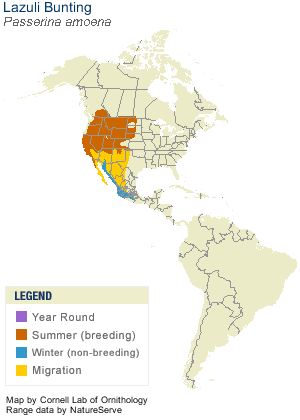
Lazuli Bunting range.
And its song is incredible! I think it just sounds like a bunch of chirping - literally - but it's because of its, well, "generic" call, that it sounds so good.

Also, they nest in shrubs close to the ground, so be sure to not step on one of their many silk-wrapped dry grass, bark and leaf nests.

There's really nothing more to be said except their range. They live out in the western half of the US, so you're not likely to see one in Maine.

-Guy

So you want me to post about pet birds...

...Okay!