I'm sorry to say that BBFG is officially canceling the Monthly Bird. We don't have the time. Sorry.

Showing posts with label Monthly Bird. Show all posts
Showing posts with label Monthly Bird. Show all posts
Friday, August 1, 2014

Sunday, June 1, 2014
Monthly Bird #6: Red-tailed Hawk
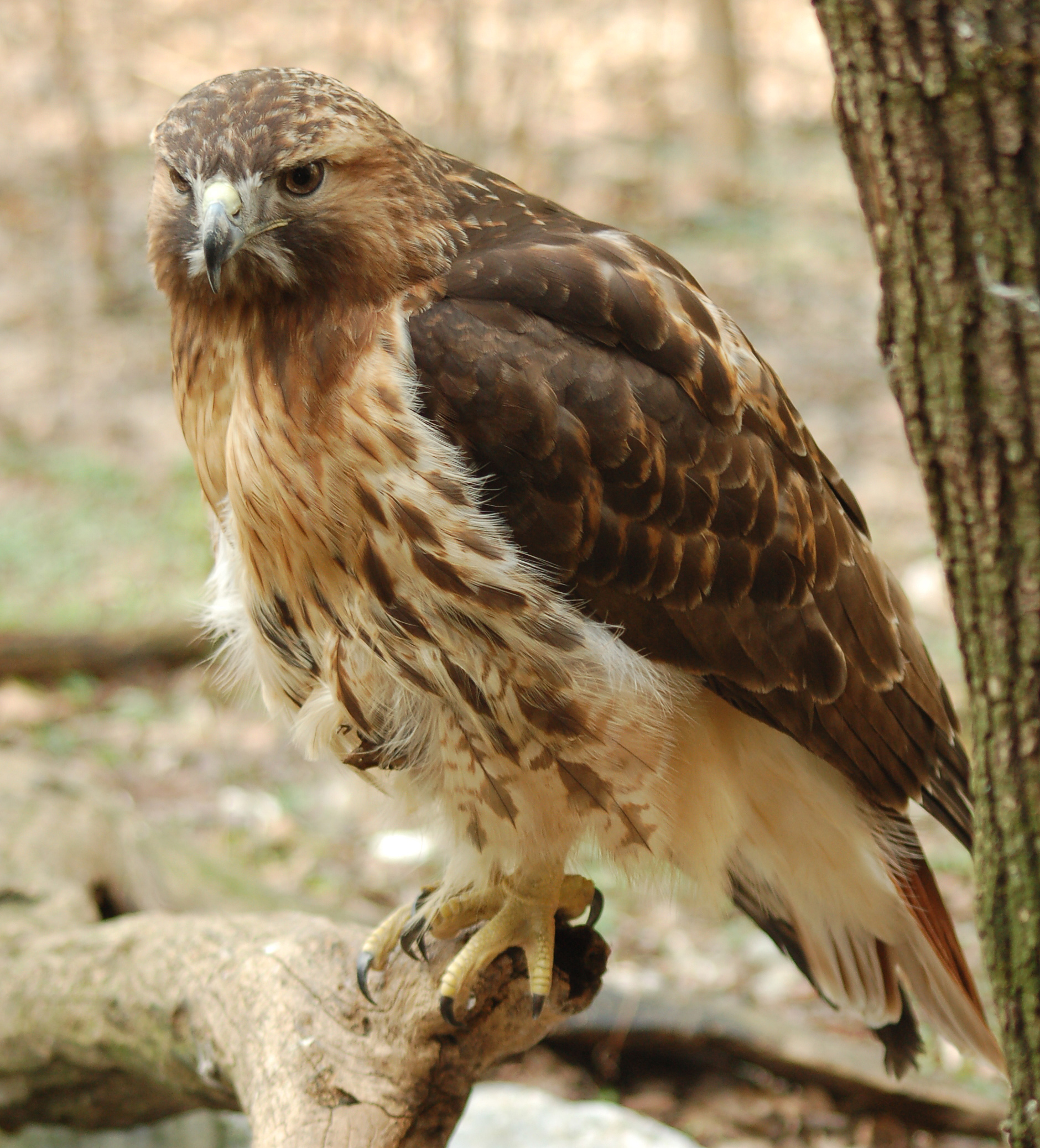 |
| Red-tailed Hawk, light morph adult. |
Also, last year I got to watch Red-tails nesting and raising young! I never came up with a name for the dad, but the mom was Jenny and their son was Ralphy. Ralphy was a troublemaker, always harassing other animals, and constantly asking his mom for food. I was a little disappointed when I figured out that the other two eggs never hatched, but even so, I still see little Ralphy everywhere.
Yet again, I had another incident with a Red-tail (not surprising): Jenny flew two feet over my head! I had no idea she was so used to humans! Wow.
 |
| When soaring, Red-tails hold their wings like Turkey Vultures. |

Thursday, May 1, 2014
Monthly Bird #5: Rose-breasted Grosbeak
Here's All About Birds's description: "Bursting with black, white, and rose-red, male Rose-breasted Grosbeaks are like an exclamation mark at your bird feeder or in your binoculars."
And I agree entirely.
In my opinion, the male Rose-breasted Grosbeak is a well-dressed bird, with its black suit, white undershirt and blood red tie. These are the key field marks for identifying one, along with the two white wing bars. The female can be tricky. It's brown with streaks on its breast, and its bill is the pale color of its eyebrow. The tricky part is that it looks so much like the female of another species, the Black-headed Grosbeak. I think the only difference is the Black-headed has a blacker head and a yellower eyebrow. Two other species it can be mixed up with are the females of both the Purple Finch and the Red-winged Blackbird.
Rose-breasted Grosbeaks eat a huge variety of insects, seeds and berries. According to All About Birds again, they eat a lot of berries: "elderberries, blackberries, raspberries, mulberries, juneberries, and seeds of smartweed, pigweed, foxtail, milkweed, plus sunflower seeds, garden peas, oats, wheat, tree flowers, tree buds, and cultivated fruit." And that's just the berries they eat - Can you even imagine how many bugs and seeds they consume?
 Like many birds, elegant grosbeak is commonly found in the eastern US and Canada, wintering in Central America and northern parts of South America, along with the Caribbean Islands. Its favorite habitat is the deciduous-coniferous forest. Other spots you might see one are: suburban areas, parks, gardens, and orchards, as well as shrubby forest edges next to streams, ponds, marshes, roads, or pastures.
And I agree entirely.
 |
| Rose-breasted Grosbeak, male. |
 |
| Rose-breasted Grosbeak, female. |
Tuesday, April 1, 2014
Monthly Bird #4: Purple Martin
Hey. Guy here - Sorry about the weird bugs in the post. I can't get rid of them.
 |
| Purple Martin, male. |
 |
| Purple martin, female. |
 |
| Purple Martin range. |
The purple finch lives in the eastern US in the summer, so you may be able to see some this year.
~ Buddy Finch
Saturday, March 1, 2014
Monthly Bird #3: Black-capped Chickadee
Who hasn't heard the ever-so familiar song of a Black-capped Chickadee?
"It's so adorable!" Due to the oversized head and curiosity about everything, the bird that most people know and love is the Black-capped Chickadee. With a black cap and neck, gray back and buffy (tannish) sides, this species is easy to recognize. Where its range overlaps with the Carolina Chickadee (the Black-cap's slightly smaller cousin), these two are easily confused and almost impossible to tell apart without hearing their different songs.
Black-capped Chickadees' brains actually grow and shrink throughout the season, due to its habit of caching food (taking from plants/feeders and storing it for later). And the more dees in a call, the higher the threat. There's a dominant hierarchy within flocks. Some birds are called "winter floaters" 'cause they don't belong to one flock. These individuals might have a different rank within each flock that they spend time in.
Ranging from the northern Pacific coast to the northern Atlantic coast, the Black-capped Chickadee is a familiar sight in and even sometimes outside its range! It is commonly found in deciduous and mixed forests, open woods, parks, willow thickets, cottonwood groves, and disturbed areas. Happy birding!
-Mr. Bird
 |
| Black-capped Chickadee, adult. |
 |
| Carolina Chickadee, adult. |
 |
| Black-capped Chickadee range. |
-Mr. Bird
Friday, January 31, 2014
The Monthly Bird #2: Common Nighthawk
 |
| Common Nighthawk, adult. |
The Common Nighthawk in the sky looks like a cross between a kestrel and a gull. It is mottled brown all over, except for the white throat patch and white lines on the under and upper parts of the wings, where a human's wrist would be. And the swift flycatching behavior is another good field mark. But the main field mark is their wing patches.
 |
| Common Nighthawk, adult, in flight. |
 |
| Common Nighthawk range. |
-Guy
Wednesday, January 1, 2014
The Monthly Bird #1: Lazuli Bunting
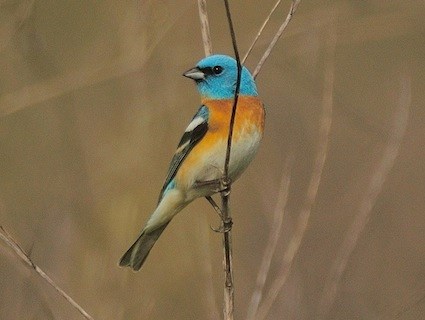 |
| Lazuli Bunting, adult male. |
You could say that about a couple hundred bird species - easily - but the Lazuli Bunting's mixture of shiny lazuli blue, bluebird brown, black and white makes this bird beyond compare.
What gives it its bright colors? I won't go into all the details, but I think it goes something like this: These things called pigments are in the feathers, and when the sun's light hits the feathers, we see the bright blue on the head and back. But colors can be tricky: Like other buntings, when not seen in good light, parts of the bird may appear dark blue or even black. I'm pretty sure that you can see the brown/orange in poor light, though.
Like most songbirds, they eat seeds, fruits and bugs. Again, like most songbirds, they come to feeders. And they're really versatile when it comes to finding food. They'll eat in the trees or in bushes, they hop on the ground like robins and they'll even flycatch for the insect portion of their diet!
And its song is incredible! I think it just sounds like a bunch of chirping - literally - but it's because of its, well, "generic" call, that it sounds so good.
Also, they nest in shrubs close to the ground, so be sure to not step on one of their many silk-wrapped dry grass, bark and leaf nests.
There's really nothing more to be said except their range. They live out in the western half of the US, so you're not likely to see one in Maine.
-Guy
What gives it its bright colors? I won't go into all the details, but I think it goes something like this: These things called pigments are in the feathers, and when the sun's light hits the feathers, we see the bright blue on the head and back. But colors can be tricky: Like other buntings, when not seen in good light, parts of the bird may appear dark blue or even black. I'm pretty sure that you can see the brown/orange in poor light, though.
Like most songbirds, they eat seeds, fruits and bugs. Again, like most songbirds, they come to feeders. And they're really versatile when it comes to finding food. They'll eat in the trees or in bushes, they hop on the ground like robins and they'll even flycatch for the insect portion of their diet!
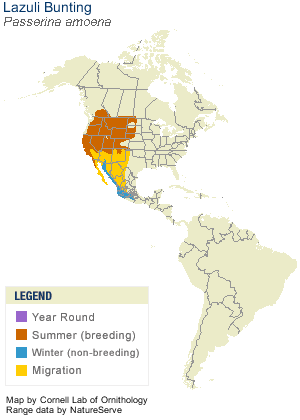 |
| Lazuli Bunting range. |
Also, they nest in shrubs close to the ground, so be sure to not step on one of their many silk-wrapped dry grass, bark and leaf nests.
There's really nothing more to be said except their range. They live out in the western half of the US, so you're not likely to see one in Maine.
-Guy
Subscribe to:
Posts (Atom)