Showing posts with label Birding. Show all posts

Sunday, June 1, 2014

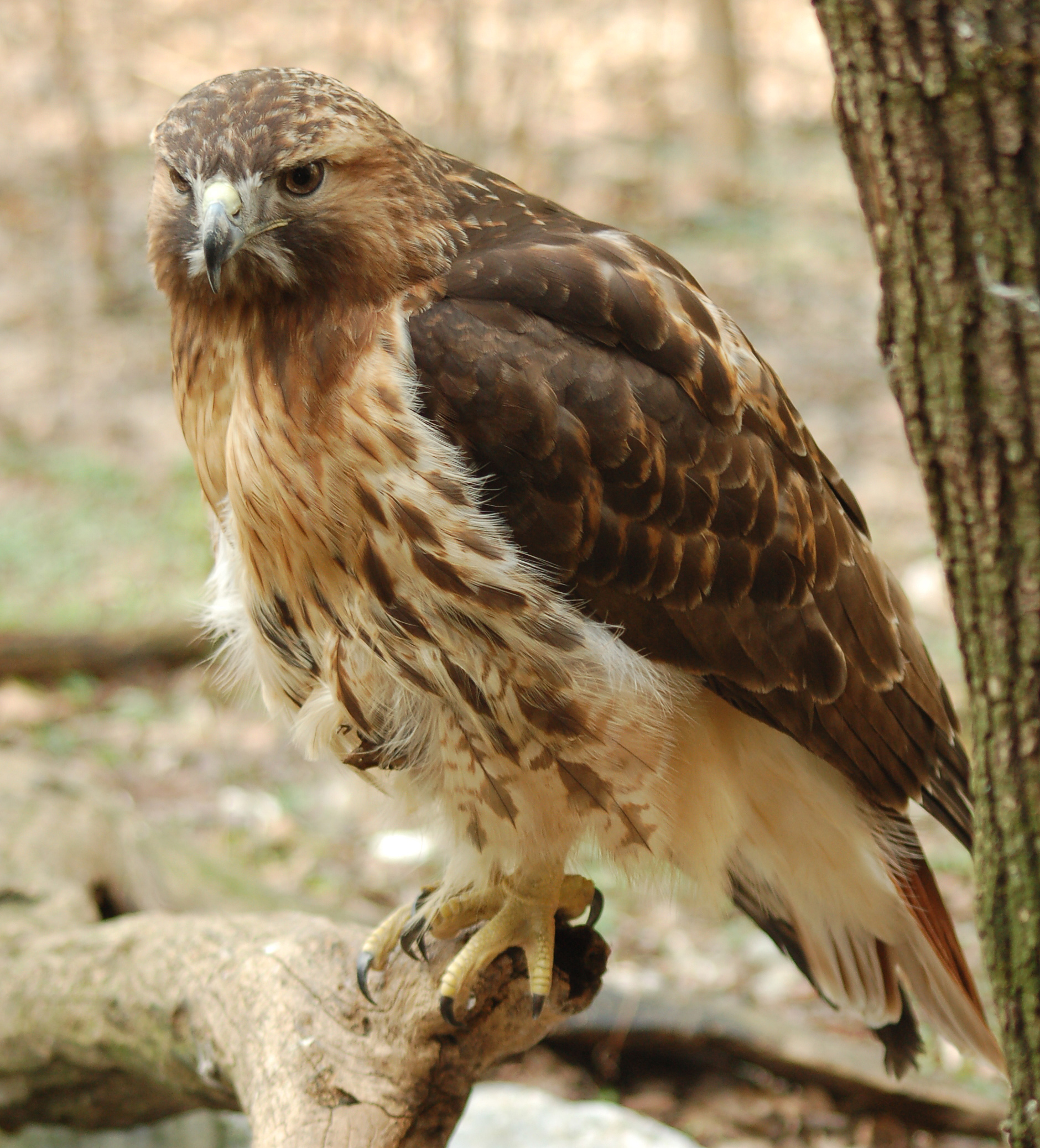
Monthly Bird #6: Red-tailed Hawk

Red-tailed Hawk, light morph adult.
 I've had many incidents with Red-tailed Hawks. Last year was really crazy: Driving home from errands with the family, a Red-tail almost hits our car! Spotting him landing in a tree, we all get out and walk over to him. By the time we all get over there, he's eyeing a squirrel with hunger in his eyes. Wow, this is amazing, I thought the entire time. I had never been this close to any wild raptor before. Eventually he got intimidated by us and flew off, looking almost disappointed he didn't catch breakfast. So then we got back in the car to drive home. In the distance, however, I could see him flying away. I like to think that he caught breakfast.

Also, last year I got to watch Red-tails nesting and raising young! I never came up with a name for the dad, but the mom was Jenny and their son was Ralphy. Ralphy was a troublemaker, always harassing other animals, and constantly asking his mom for food. I was a little disappointed when I figured out that the other two eggs never hatched, but even so, I still see little Ralphy everywhere.


Yet again, I had another incident with a Red-tail (not surprising): Jenny flew two feet over my head! I had no idea she was so used to humans! Wow.


When soaring, Red-tails hold their wings like Turkey Vultures.
Red-tailed Hawks come in tons of different colours, varying from off white to jet black. The most common ones are usually lightish brown, though. Being the most common and widespread raptor in North America, they are very adaptable. You'll find them everywhere. Everywhere except forests, that is. Their preferred habitat is open fields, where the hawks can find mice, rabbits, voles, wood mice, and sometimes large birds, such as grouse and turkeys. You'll see them carrying food less than an ounce to over five pounds!

What I'm getting at here is that no matter where you go hawk watching, you're sure to see a Red-tail or two.

Friday, May 23, 2014

More pictures from the Birdfest

Chase, a Cooper's Hawk. Wing damage.
Stella the Peregrine - A retired falconry bird.
Phoenix the Red-tail. Blind in the left eye.
A baby Painted Turtle - They have one every year.

Monday, April 7, 2014

Birdlog #8 - 4-7-14: Another list

I went birding again with a friend, and this is what we saw:
  • 1 Turkey Vulture
  • 1 Sharp-shinned/Cooper's Hawk
  • 2 Mourning Doves
  • 1 Downy/Hairy Woodpecker (heard only)
  • 1 American Crow
  • 4 Black-capped Chickadees
  • 1 White-breasted Nuthatch
  • 8 American Robins
  • 1 European Starling
  • 1 Dark-eyed Junco (Slate-colored)
  • 5 Northern Cardinals
  • 1 Common Grackle
  • 4 Brown-headed Cowbirds
  • 5 House Sparrows
I organized an event called the Big Week, based on the Big Year and the Big Day. Basically the same thing, but it lasts for a week. I used a checklist by the North Central Illinois Ornithological Society (NCIOS) to count the species. I'll probably post a list of all the birds I've seen every day this week (but don't count on it).

End.

Thursday, March 27, 2014

Birdlog #8 - 3-27-14: Birding at a lek during migration...

... Rocks.

You're probably wondering what a lek is (unless you're an obsessive bird nerd who knows every obscure term ever used anywhere). A lek is where adult male birds can do courtship displays, and females will come and watch. I think they're only used by plovers, grouse and some birds-of-paradise.


Anyway, here's the list:


  • 5 Canada Geese
  • 2 Mallards
  • 1 Turkey Vulture
  • 3 Bald Eagles
  • 1 Red-tailed Hawk
  • 20-30 Sandhill Cranes - The first I've seen in Illinois!
  • 11 Killdeer
  • 1 Peregrine Falcon
  • 1 Blue Jay
  • 2 American Robins
  • 1 European Starling
  • 1 Cedar Waxwing - possible
  • 3 House Sparrows
The species that really stick out to me are: Bald Eagle, Sandhill Crane and Peregrine Falcon. The Killdeer were the only ones actually using the lek, but there were other birds around. Here's the really crazy part: We saw all of those birds in twenty minutes!

And once again, I didn't have my camera with me - It's outta battery, anyway.

End.

Monday, January 27, 2014

Tips for beginning birdwatchers - Bill Thompson, III

  1. Get a decent pair of binoculars, one that is easy for you to use and hold steady.
  2. Find a field guide to the birds of your region. (Many guides, like this one, cover only eastern or western North America.) Guides that cover all the birds of North America contain many species that are uncommon or entirely absent from your area. You can always upgrade to a continent-wide guide later.
  3. Set up a basic feeding station in your yard or garden.
  4. Start with backyard birds. They are easiest to see, and you can become familiar with them fairly quickly.
  5. Practice your identification skills. Starting with a common bird species, note the most obvious visual features of the bird (color, size, shape, patterns in the plumage). These features are known as field marks and will be helpful clues to the bird's identity.
  6. Notice the bird's behavior. Many birds can be identified by their behavior--woodpeckers peck on wood, kingfishers hunt for small fish, swallows are known for their graceful flight.
  7. Listen to the bird's sounds. Bird song is a vital component to birding. Learning bird songs and sounds takes a bit of practice, but many birds make it pretty easy for us. For example, chickadees and Whip-poor-wills (among others) call out their names. In the Young Birder's Guide to Birds of North America, the Resources section contains a list of tools to help you learn bird songs.
  8. Look at the bird, not the book.* When you see an unfamiliar bird, avoid the temptation to glance at the bird and grab the guide. Instead, watch the bird carefully for as long as it is present. Your field guide will be with you long after the bird is gone, so take advantage of every moment to watch an unfamiliar bird while you can.
  9. Take notes. No one can be expected to remember every field mark and description of a bird. But you can help you memory and accelerate your learning by taking note on the birds you see. These notes can be written in a small pocket notebook or even in the margins of your field guide.
  10. Venture beyond the backyard and find other bird watchers in your area. The bird watching you'll experience beyond your backyard will be enriching, especially if it leads not only to new birds but also to new birding friends. Ask a local nature center or wildlife refuge about bird clubs in your region. You state ornithological organization or natural resources division may also be helpful. Being with others who share your interest in bird watching can greatly enhance your enjoyment of this wonderful hobby.
That was straight from Bill Thompson, III's "the Young Birder's Guide to Eastern Birds of North America."

-Guy

Thursday, January 23, 2014

ABA Principles of Birding Ethics

Everyone who enjoys birds and birding must always respect wildlife, its environment, and the rights of others. In any conflict of interest between birds and birders, the welfare of birds and their environment comes first.

CODE OF BIRDING ETHICS

1. Promote the welfare of birds and their environment.
1(a) Support the protection of important bird habitat.
1(b) To avoid stressing birds or exposing them to danger, exercise restraint and caution during observation, photography, sound recording, or filming. Limit the use of recordings and other methods of attracting birds, and never use such methods in heavily birded areas or for attracting any species that is Threatened, Endangered, or of Special Concern, or is rare in your local area. Keep well back from nest sites and nesting colonies, roosts, display areas, and important feeding sites. In such sensitive areas, if there is a need foe extended observation, photography, filming, or recording, try to use a blind or hide, and take advantage of natural cover. Use artificial light sparingly for filming or photography, especially for close-ups.
1(c) Before advertising the presence of a rare bird, evaluate the potential for disturbance to the bird, its surroundings, and other people in the area, and proceed only if access can be controlled, disturbance can be minimized, and permission has been obtained from private land-owners. The sites of rare nesting birds should be divulged only to the proper conservation authorities.
1(d) Stay on roads, trails, and paths where they exist; otherwise keep habitat disturbance to a minimum.
2. Respect the law and the rights of others.

2(a) Do not enter private property without the owner's permission.
2(b) Follow all laws, rules, and regulations governing the use of roads and public areas, both at home and in abroad.
2(c) Practice common courtesy in contacts with other people. .* Your exemplary behavior will generate goodwill with birders and non-birders alike.
3. Ensure that feeders, nest structures, and other artificial bird environments are safe.
3(a) Keep dispensers, water, and food clean and free of decay or disease. It is important to feed birds continually during harsh winter.
3(c)* If you are attracting birds to an area, ensure the birds are not exposed to predation by cat and other domestic animals, or dangers posed by artificial hazards.
4. Group birding, whether organized or impromptu, requires special care.
Each individual in the group, in addition to the obligations spelled out in Items #1 and #2, has responsibilities as a Group Member.
4(a) Respect the interests, rights, and skills of fellow birders, as well as those of people participating in other legitimate outdoor activities. Freely share your knowledge and experience, except where code 1(c) applies. Be especially helpful to beginning birders.
4(b) If you witness unethical birding behaviors, assess the situation and intervene if you think it prudent. When interceding, inform the person(s) of the inappropriate action and attempt, within reason, to have it stopped. If the behavior continues, document it and notify appropriate individuals or organizations.

Group Leader Responsibilities [amateur and professional trip and tours].
4(c) Be an exemplary ethical role model for the group. Teach through word and example.
4(d) Keep groups to a size that limits impact on the environment and does not interfere with others using the same area.
4(e) Ensure everyone in the group knows of and practices this code.**
4(f) Learn and inform the group of any special circumstances applicable to the areas being visited (e.g., not tape recorders allowed).
4(g) Acknowledge that professional tour companies bear a special responsibility to place the welfare of birds and the benefits of public knowledge ahead of the company's commercial interests. Ideally, leaders should keep track of tour sightings, document unusual occurrences, and submit records to appropriate organizations.

PLEASE FOLLOW THIS CODE--DISTRIBUTE IT AND TEACH IT TO OTHERS.
Additional copies of the Code of Birding Ethics can be obtained from: ABA, 4945 N. 30th Street, Suite 200, Colorado Springs, CO 80919-3151, (800) 850-2473 or (719) 578-1480; email: member@aba.org
This ABA Code of Ethics may be reprinted, reproduced, and distributed without restriction.
Please acknowledge the role of ABA in developing and promoting this code. 7/1/96
 
Wow. That was a lot to type. Anyway, the link to the PDF so you can print it (or save it) is right here. If you ever go birding, remember the ABA Principles of Birding Ethics. (Yeah, I know, "that's too long to memorize!" Well, tough luck.)
 
*All mistakes with an asterisk adjacent to them are mistakes in the actual document.
**I'm kinda iffy about this one.
 
-Guy