

Showing posts with label Bird. Show all posts
Showing posts with label Bird. Show all posts
Thursday, November 27, 2014

Monday, September 15, 2014
What makes a bird a bird
 |
| Blue macaw feathers. |
- Eggs - Birds lay eggs, but so do reptiles, amphibians, insects and platypuses. (Platypusi? Platypus?)
- Bipedalism - Birds walk on two feet. But so do we.
- Beak - All birds have beaks, also known as bills. But turtles have them too!
- Wings - They have wings too, but so do bats.
- Feathers - Now, besides birds, can you think of a single animal that has feathers? No.
Feathers are very complex. There are a ton of parts to each type of feather - And there are a couple feather types!
I'll start with the type most commonly found and prized feather, the primary flight feather (There are secondaries, too, but those are generally just shorter). There is the pennaceous region, the part where all the itty-bitty barbs stick together. The barbs are the main branches that stick out from the central shaft, or rachis. The calamus is the hollow base of the central shaft where the muscles attach. Finally, the plumulaceous region is that really fluffy part at near the bottom of the feather where the bars don't interlock like the rest of the feather.
I would talk about all of the feathers if I had time, but I don't, so let's move on. What's something that differentiates birds from other organisms? The syrinx. We have a larynx. Basically our vocal cords. Ours look like a long tube. But birds' vocal cords look like a tube that splits at the bottom, thus letting them generate two noises at once.
I know I didn't explain a lot about either of these subjects, so if you want more info, visit All About Bird Biology by the Cornell Lab of Ornithology.
I'll start with the type most commonly found and prized feather, the primary flight feather (There are secondaries, too, but those are generally just shorter). There is the pennaceous region, the part where all the itty-bitty barbs stick together. The barbs are the main branches that stick out from the central shaft, or rachis. The calamus is the hollow base of the central shaft where the muscles attach. Finally, the plumulaceous region is that really fluffy part at near the bottom of the feather where the bars don't interlock like the rest of the feather.
I would talk about all of the feathers if I had time, but I don't, so let's move on. What's something that differentiates birds from other organisms? The syrinx. We have a larynx. Basically our vocal cords. Ours look like a long tube. But birds' vocal cords look like a tube that splits at the bottom, thus letting them generate two noises at once.
I know I didn't explain a lot about either of these subjects, so if you want more info, visit All About Bird Biology by the Cornell Lab of Ornithology.
Sunday, September 14, 2014
Northern Illinois Raptor Rehab presentation
Yesterday I went to a program in a local forest preserve that was hosted by the Northern Illinois Raptor Rehab. It was, of course, on raptors. They had a bunch of cool birds. I think there were 7 species there. They had a great horned owl, a barred owl, two Eastern screech-owls, a Northern saw-whet owl, a barn owl, a peregrine falcon, and two American kestrels.
Cathy, the speaker, spoke on a variety of subjects: "What are raptors?" "Are they in my backyard?" "How many species of raptors are there in Illinois?" And she answered those - plus more - fully.
 Like most of the raptors they had there, Ulysses (above) was imprinted. Being imprinted makes you unreleasable. It means that when any bird opens its eyes, the first thing it sees, to the bird, is its mother.
 That's Stella, the peregrine falcon. I think Cathy said that Stella was a retired falconry bird. Falconry is the old sport of training a falcon or hawk to hunt food, then bring it back. She has raised six foster chicks. There is also something wrong with her foot. She's a really flighty bird! As she came out of her box and alighted on a handler's glove, she just started flapping like crazy! As she started flapping, she quacked like a duck. Maybe that and their food (ducks) is where they get the old name, duck hawk, from.
 Sky is a female red-tailed hawk with a broken wing, I think. Notice how she holds her right wing higher than the left. That's because of her break. There's not a lot to say about her.
 Orion and Ophelia, the two Eastern screech-owls, are really, really cuddly. Orion (left) is imprinted. Ophelia (guess where she is) is blind in one eye and has a broken right wing. She was hit by a car. I can't even remember how many foster chicks they've raised. Well over ten!
 I don't remember this big guy's name. I think he's imprinted. There's not much to say about him, either.


Then there's the two American kestrels. I don't remember their names either (don't blame me! Those were a lot of weird names). I think they were imprinted, too.
 And last but not least, there's the barn owl. Barn owls are endangered in Illinois, yet they're the most widely distributed owl in the world! He was spooky. But when he looks right at you, he's kinda cute!
So now that you've seen all of these birds, maybe you wanna come to one of the NIRRRE's presentations! They're really cool, and you learn a lot. Their full name is the Northern Illinois Raptor Rehabilitation and Education. They "rescue, rehabilitate and release." Click here to go to their website.
Cathy, the speaker, spoke on a variety of subjects: "What are raptors?" "Are they in my backyard?" "How many species of raptors are there in Illinois?" And she answered those - plus more - fully.
Then there's the two American kestrels. I don't remember their names either (don't blame me! Those were a lot of weird names). I think they were imprinted, too.
So now that you've seen all of these birds, maybe you wanna come to one of the NIRRRE's presentations! They're really cool, and you learn a lot. Their full name is the Northern Illinois Raptor Rehabilitation and Education. They "rescue, rehabilitate and release." Click here to go to their website.
Friday, August 1, 2014
Feeder reminder

Don't forget to put up all of your feeders this month! Warblers, hummingbirds and orioles will be migrating through this August. Also remember to clean out your feeders - you don't want any dead ruby-throats or Baltimore orioles lying around your feeding station.
Sunday, June 1, 2014
Monthly Bird #6: Red-tailed Hawk
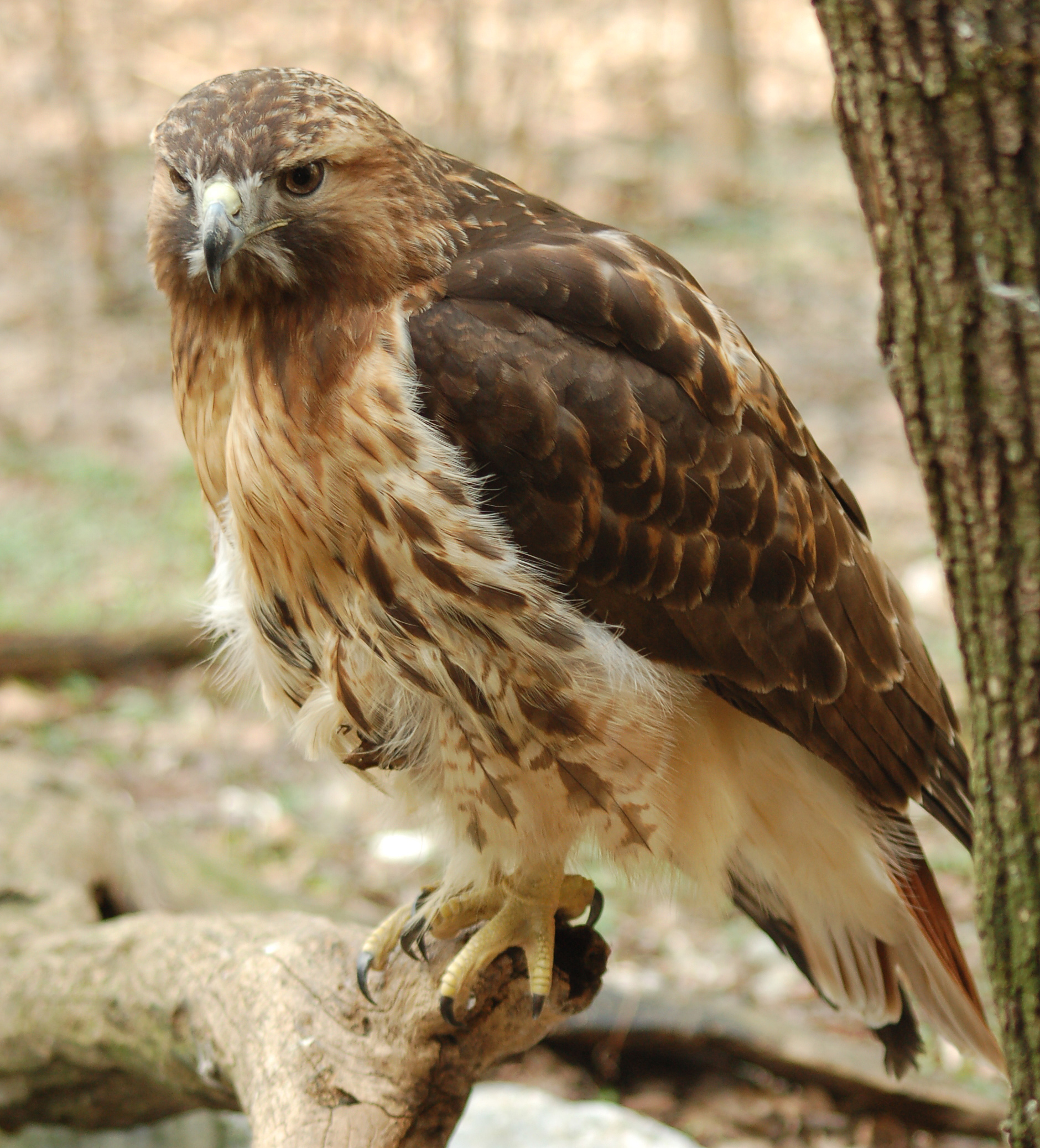 |
| Red-tailed Hawk, light morph adult. |
Also, last year I got to watch Red-tails nesting and raising young! I never came up with a name for the dad, but the mom was Jenny and their son was Ralphy. Ralphy was a troublemaker, always harassing other animals, and constantly asking his mom for food. I was a little disappointed when I figured out that the other two eggs never hatched, but even so, I still see little Ralphy everywhere.
Yet again, I had another incident with a Red-tail (not surprising): Jenny flew two feet over my head! I had no idea she was so used to humans! Wow.
 |
| When soaring, Red-tails hold their wings like Turkey Vultures. |

Friday, May 23, 2014
More pictures from the Birdfest
 |
| Chase, a Cooper's Hawk. Wing damage. |
 |
| Stella the Peregrine - A retired falconry bird. |
 |
| Phoenix the Red-tail. Blind in the left eye. |
 |
| A baby Painted Turtle - They have one every year. |
Friday, May 2, 2014
New site: All About Feathers
Cornell Birds has a new website: All About Feathers!
This new site goes really in-depth about feathers. There's not much else to say. Check it out!
This new site goes really in-depth about feathers. There's not much else to say. Check it out!
Thursday, May 1, 2014
Monthly Bird #5: Rose-breasted Grosbeak
Here's All About Birds's description: "Bursting with black, white, and rose-red, male Rose-breasted Grosbeaks are like an exclamation mark at your bird feeder or in your binoculars."
And I agree entirely.
In my opinion, the male Rose-breasted Grosbeak is a well-dressed bird, with its black suit, white undershirt and blood red tie. These are the key field marks for identifying one, along with the two white wing bars. The female can be tricky. It's brown with streaks on its breast, and its bill is the pale color of its eyebrow. The tricky part is that it looks so much like the female of another species, the Black-headed Grosbeak. I think the only difference is the Black-headed has a blacker head and a yellower eyebrow. Two other species it can be mixed up with are the females of both the Purple Finch and the Red-winged Blackbird.
Rose-breasted Grosbeaks eat a huge variety of insects, seeds and berries. According to All About Birds again, they eat a lot of berries: "elderberries, blackberries, raspberries, mulberries, juneberries, and seeds of smartweed, pigweed, foxtail, milkweed, plus sunflower seeds, garden peas, oats, wheat, tree flowers, tree buds, and cultivated fruit." And that's just the berries they eat - Can you even imagine how many bugs and seeds they consume?
 Like many birds, elegant grosbeak is commonly found in the eastern US and Canada, wintering in Central America and northern parts of South America, along with the Caribbean Islands. Its favorite habitat is the deciduous-coniferous forest. Other spots you might see one are: suburban areas, parks, gardens, and orchards, as well as shrubby forest edges next to streams, ponds, marshes, roads, or pastures.
And I agree entirely.
 |
| Rose-breasted Grosbeak, male. |
 |
| Rose-breasted Grosbeak, female. |
Monday, April 7, 2014
Birdlog #8 - 4-7-14: Another list
I went birding again with a friend, and this is what we saw:
- 1 Turkey Vulture
- 1 Sharp-shinned/Cooper's Hawk
- 2 Mourning Doves
- 1 Downy/Hairy Woodpecker (heard only)
- 1 American Crow
- 4 Black-capped Chickadees
- 1 White-breasted Nuthatch
- 8 American Robins
- 1 European Starling
- 1 Dark-eyed Junco (Slate-colored)
- 5 Northern Cardinals
- 1 Common Grackle
- 4 Brown-headed Cowbirds
- 5 House Sparrows
I organized an event called the Big Week, based on the Big Year and the Big Day. Basically the same thing, but it lasts for a week. I used a checklist by the North Central Illinois Ornithological Society (NCIOS) to count the species. I'll probably post a list of all the birds I've seen every day this week (but don't count on it).
End.
Tuesday, April 1, 2014
Monthly Bird #4: Purple Martin
Hey. Guy here - Sorry about the weird bugs in the post. I can't get rid of them.
 |
| Purple Martin, male. |
 |
| Purple martin, female. |
 |
| Purple Martin range. |
The purple finch lives in the eastern US in the summer, so you may be able to see some this year.
~ Buddy Finch
Saturday, March 1, 2014
Monthly Bird #3: Black-capped Chickadee
Who hasn't heard the ever-so familiar song of a Black-capped Chickadee?
"It's so adorable!" Due to the oversized head and curiosity about everything, the bird that most people know and love is the Black-capped Chickadee. With a black cap and neck, gray back and buffy (tannish) sides, this species is easy to recognize. Where its range overlaps with the Carolina Chickadee (the Black-cap's slightly smaller cousin), these two are easily confused and almost impossible to tell apart without hearing their different songs.
Black-capped Chickadees' brains actually grow and shrink throughout the season, due to its habit of caching food (taking from plants/feeders and storing it for later). And the more dees in a call, the higher the threat. There's a dominant hierarchy within flocks. Some birds are called "winter floaters" 'cause they don't belong to one flock. These individuals might have a different rank within each flock that they spend time in.
Ranging from the northern Pacific coast to the northern Atlantic coast, the Black-capped Chickadee is a familiar sight in and even sometimes outside its range! It is commonly found in deciduous and mixed forests, open woods, parks, willow thickets, cottonwood groves, and disturbed areas. Happy birding!
-Mr. Bird
 |
| Black-capped Chickadee, adult. |
 |
| Carolina Chickadee, adult. |
 |
| Black-capped Chickadee range. |
-Mr. Bird
Friday, January 31, 2014
The Monthly Bird #2: Common Nighthawk
 |
| Common Nighthawk, adult. |
The Common Nighthawk in the sky looks like a cross between a kestrel and a gull. It is mottled brown all over, except for the white throat patch and white lines on the under and upper parts of the wings, where a human's wrist would be. And the swift flycatching behavior is another good field mark. But the main field mark is their wing patches.
 |
| Common Nighthawk, adult, in flight. |
 |
| Common Nighthawk range. |
-Guy
Sunday, September 22, 2013
Why vultures aren't buzzards, why nighthawks aren't hawks, and why all gulls aren't seagulls
Have you ever heard someone say, "Look! a buzzard!"? I have. It's annoying. And one time heard is one time too many.
Don't. Misuse. Bird names. EVER.
The term buzzard came from Europeans, who used the word to name Buteos, or large hawk that soar. But us silly Americans have, like so many other things, misused it. And now (unfortunately) too many people think that a vulture is a buzzard. Incorrect, I say! Incorrect!
But I have more evidence. Buzzard hawks (Buteos) kill and eat freshly killed prey. They're hunters. Vultures eat carrion, or things that have already died. They're scavengers.
Nighthawks aren't hawks. They're just nocturnal, flycatching birds that look like hawks. Their diet, behavior and "cousins" are totally different! Nighthawks are members of the "Goatsucker" family because they were mistaken to drink goat's (and other livestock's) blood! But they don't, so you farmers don't worry. What nighthawks do for a "living" is pretty much a duller version of what hawks do. Nighthawks eat flies and other flying insects. Hawks eat birds and other flying creatures (along with rodents, but that's not what I'm trying to get at).
Gulls... I don't know a single person who hasn't heard or said "seagull". Everybody's so used to saying it that nobody says "gull" anymore! I know what you're saying: "But some gulls live by the sea!" Yes they do. And those and only those are seagulls. All the rest are gulls. It's that simple.
So what I'm trying to say is that many people use many incorrect names for birds, and if you're not sure about it, look it up. Happy birding!
"Look! A yellow finch!"
He means Goldfinch. Whoopsie daisy.
-Mr. Bird
Don't. Misuse. Bird names. EVER.
 |
| Turkey |
But I have more evidence. Buzzard hawks (Buteos) kill and eat freshly killed prey. They're hunters. Vultures eat carrion, or things that have already died. They're scavengers.
 |
| Common Nighthawk, adult. |
 |
| Laughing Gull, adult, in flight. |
So what I'm trying to say is that many people use many incorrect names for birds, and if you're not sure about it, look it up. Happy birding!
"Look! A yellow finch!"
He means Goldfinch. Whoopsie daisy.
-Mr. Bird
 |
| Goldfinch. Not yellow finch. Remember that. |
Wednesday, February 27, 2013
Creeper, Creeper, Creeper!
 |
| Brown Creeper. |
Creepers, like most birds, depend on trees greatly (I'm NOT an environmentalist). They fInd their food in tree's bark, they nest behind peeling bark, and they even look like bark!
 |
| Brown Creeper: Brown morph |
The full-grown bird is 5 1/2" long.
Brown Creepers usually live in mature evergreen-deciduous woodlands, but once they find a suet feeder, they will visit regularly. In the West, you can find them as high as 11,000 feet!
 |
| Brown Creeper: Red morph |
The Brown Creeper really is a fascinating bird, so get to a window or get out in the field and get birdwatching! Happy birding!
-Mr. Bird
Subscribe to:
Posts (Atom)